Saturday, May 1, 2010

EXPO SHANGAI 2010 CHINA

A Exposição Mundial de Xangai China 2010, também conhecida como Expo 2010, será realizada em Xangai, na China de 1 de Maio a 31 de Outubro de 2010. Esta é a primeira Exposição Mundial a ser realizado pela China e é outro grande evento internacional após as Olimpíadas de 2008.

O tema da Expo 2010 é "Better City, Better Life". O local de realização da Expo 2010 está localizado entre a Ponte Nanpu e a Ponte Lupu, em área da zona portuária de ambos os lados do rio Huangpu, cobrindo uma área de 5,28 km ². Um total de 192 países e 50 organizações internacionais confirmaram formalmente a sua presença na Expo, que deverá atrair 70 milhões de visitantes provenientes da China e do exterior.

O Pavilhão de Macau - Jade Coelho da Lanterna Imperial" foi erigido no interior do Pavilhão da China e é uma réplica da Casa de Penhores "Tak Seng On" e foi construído no ‘Expo's Best Practices’ para o Espaço Urbano. Macau vai também participar na Expo "on-line" iniciativa que espera mais de 100 apresentações.

O Pavilhão de Macau assume a forma de um pé de coelho sobre uma lanterna realizado em tradicionais paralelepípedos Portugueses, simbolizando a Macau como uma mistura harmoniosa das culturas oriental e ocidental. "Macau - Espírito de Culturas, Essência de Harmonia" é o tema da RAEM na Expo 2010.

O Pavilhão de Macau tem 19,99 metros de altura, simbolizando o retorno de Macau à China em 1999. Posicionado como uma lanterna de cor no Pavilhão China Avenue. o pavilhão Jade Coelho recebe visitantes de todo o mundo ao Pavilhão Nacional Chinês, refletindo em pleno execução da política da China "um país dois sistemas". A parede externa é feita de vidro refletivo, que ilumina o Pavilhão da China durante o dia, o que representa o conceito "A China no coração de Macau". A parede exterior pode ser convertida para mostrar diferentes cores na noite, que reflete a vitalidade e o dinamismo de Macau.

O Pavilhão de Macau é um gigante teatro, com o anel interno agindo como um "Ring of Time" e do anel exterior como "Ring of Harmony". O anel interno representa cinco andares do teatro circular de 360 graus, enquanto que o "Ring of Harmony" é dividido em quatro secções, "Harmonia entre terra e mar", "Harmonia cultural ", "Harmonia entre as tradições e a modernidade" e "Harmonia dinâmica ". Através destas áreas, os visitantes podem embarcar numa viagem mágica através dos tempos para experimentar o desenvolvimento de Macau a partir de uma pequena vila de pescadores para uma cidade turística internacional, com a mensagem implícita de "regresso à Pátria, Macau uma cidade melhor!".

"Tak Seng On" destacou-se e foi escolhida no processo de seleção para a Melhor Actuação de Área Urbana, devido ao seu modelo de gestão inovador de cooperação entre o governo, as empresas públicas e privadas. A réplica do "Tak Seng On" incidirá sobre os esforços de Macau e conquistas em matéria de conservação e revitalização das suas construções históricas, e ao mesmo tempo, promover as indústrias culturais e criativas de Macau através de uma exposição interna, cumprindo assim a política do Governo da RAEM de criação de uma economia moderadamente diversificada.

Em 2009, o Governo da RAEM deu autorização a un Yong para mostrar os seus trabalhos, fazendo "Tak Seng On" e será um dos destaques da Expo 2010. Alguns dos atletas de artes marciais premiados no ‘Macao’s International Awards’ vão representar o papel de alguns dos personagens mais famosos das novelas un Yong. Esta exposição visa não apenas trazer a várias personalidades em novelas un Yong à vida, mas também revelar o talento e as realizações proeminentes das artes marciais em Macau para o mundo.

"Tak Sen On" continuará a ser uma característica permanente da Expo2010. Ele será preservado in situ após o evento como um marco permanente, que representará Macau em Xangai.


The World Exposition Shanghai China 2010, otherwise known as Expo 2010, will be held in Shanghai, China from May 1 to October 31, 2010. This is the first ever World Exposition to be held by China and is another major international event after the 2008 Beijing Olympics.

The theme of the Expo 2010 is “Better City, Better Life”. The site of Expo 2010 is located between the Nanpu Bridge and Lupu Bridge in the waterfront area on both sides of the Huangpu River, covering an area of 5.28 sq km. A total of 192 countries and 50 international organizations have formally confirmed their presence in the expo, which is expected to attract 70 million visitors from China and abroad.

The “Macau Pavilion - Jade Rabbit the Imperial Lantern” was erected inside the China Pavilion Zone and the replica of Pawnshop “Tak Seng On” was built in the Expo’s Urban Best Practices Area. Macao will also participate in the “Expo On-line” initiative and hold more than 100 performances. The Macau Pavilion takes the shape of a rabbit lantern standing on traditional Portuguese cobblestones, symbolizing Macao as a harmonious blend of Eastern and Western cultures. “Macao - Spirit of Cultures, Essence of Harmony” is the theme of the MSAR at the Expo 2010.
The Macau Pavilion is 19.99 meters high, symbolizing Macao’s return to China in 1999. Positioned as a colored lantern in the China Pavilion Avenue. the Jade Rabbit pavilion welcomes visitors from across the world to the Chinese National Pavilion, while fully reflecting China’s implementation of the “one country two systems” policy. The external wall is made of reflective glass which illuminates the China Pavilion during the day, which represents the concept “China in Macao’s Heart”. The exterior wall can be converted to show different colors at night, which reflects the vitality and dynamism of Macao.

The Macau Pavilion is a giant theatre, with the inner ring acting as a “Ring of Time” and the outer ring as a “Ring of Harmony”. The inner ring is a five-storey 360 degree circular theater, whereas the “Ring of Harmony” is divided into four sections, “Harmony between Land and Sea”, “Cultural Harmony”, “Harmony between Traditions and Modernity” and “Dynamic Harmony”. Through these areas, visitors can embark on a magical journey through time to experience the development of Macao from a small fishing village to an international tourist city, with the underlying message of “Return to the motherland, Macao a better city!”. “Tak Seng On” stood out and was chosen in the fierce selection process for the Urban Best Practices Area due to its innovative management model involving cooperation between the government, the public and private enterprises. The “Tak Seng On” replica will focus on Macao’s efforts and achievements regarding the conservation and revitalization of its historical buildings, and will, at the same time, promote Macaos cultural and creative industries through an internal exhibition, thereby fulfilling the MSAR Government’s policy of creating a moderately diversified economy.

In 2009, the Government of the MSAR was given authorization by un Yong to display his works, making “Tak Seng On” one of the highlights of Expo 2010. Some of Macao’s international award winning martial arts athletes will reprise the roles of some of the most iconic characters from un Yong’s novels. This display not only aims to bring the various personalities in un Yong’ novels to life, but also to reveal the prowess and outstanding achievements of martial arts in Macao to the world.

“Tak Sen On” will remain a permanent feature of the Expo2010. It will be preserved in situ after the event, as a permanent landmark representing Macao in Shangai.


The Stamps:

The Blocs of Four Souvenir Sheets:
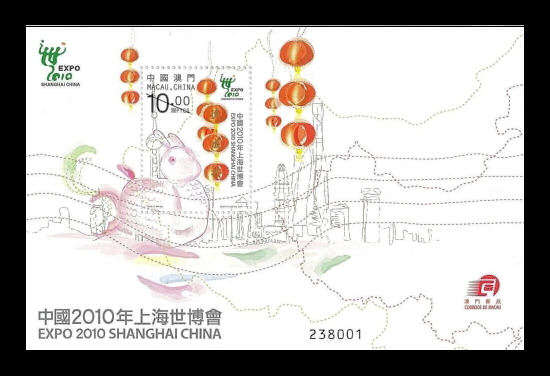
The Souvenir Sheet:

The FDC with Stamps:

The FDC with Souvenir Sheet:

The Post Mark:

Dados Técnicos/Technical Data
Valor dos Selos/Stamps Value: stamps of 3.50 and 4.00 Patacas
Folhas com 50 selos de cada taxa/Sheets of 50 stamps of each value
Valor do Bloco/Souvenir Sheet Value: 10.00 Patacas
Folhas especiais com quadras de blocos/Special sheets with four souvenir sheets Desenho/Design: Chio Ut Sim
Data emissão/Issue date: 01.05.2010
Impressor/Printer: Jon.Enschedé Security Print, Netherlands
Impressão/Print: Offset Lithography
Papel/Paper: Paper with Security Fibers
Picotagem/Perforation: 14 x 13¼

Tuesday, April 6, 2010

Welcome the 4000th visitors

Aqui ficam as melhores saudações Filatélicas, para os visitantes de todo o mundo, que diariamente visitam o meu blog.

(English version)

Here are the best Philatelic greetings to visitors from all over the world who daily visit my blog.

Monday, March 8, 2010

Centenário do Dia Internacional da Mulher / Centenary of International Women's Day

8 de Marco de 2010 comemora-se o Centenário do Dia Internacional da Mulher.

Durante este centenário mulheres de diversos países têm-se esforçado para conseguir os direitos para si próprias. A Aaividade internacional das mulheres tem alcançado grande sucesso na promoção da paz, do progresso e desenvolvimento para muitos povos. Dia Internacional da Mulher é digno de comemoração e assim Correios de Macau emitiu selos especiais para celebrar e comemorar este dia especial. Dia Internacional da Mulher é conhecido como o Dia Internacional da Mulher Trabalhadora ", também conhecida como" Dia das Nações Unidas para os Direitos da Mulher e da paz internacional ", ou " Dia 8 de março Internacional da Mulher ", um dia glorioso, em todo o mundo, para marcar a unidade das mulheres e a luta pelos seus direitos. Neste dia, em diferentes continentes do mundo inteiro, as mulheres de diversas nacionalidades, raça, língua, cultura e diferença em termos económicos e políticos que expressam sua preocupação sobre os seus direitos, o seu estatuto e o desenvolvimento das mulheres.
No século XVIII, Idade da Europa do Iluminismo estabeleceu as bases da idéia de igualdade de ambos os sexos, e a Revolução Francesa criaram um palco que deu actividades Romen de um impulso e foi um ponto de viragem no seu desenvolvimento. A partir de então as actividades sociais organizadas por grupos de mulheres têm florescido, tendo o objetivo de eliminar a discriminação sexual e melhorar o seu estatuto pessoal.

Em 1909, em Chicago E.U.A., as mulheres de trabalho realizada uma grande greve e de manifestação, que foi apoiado por muitas mulheres, a luta pela sua liberdade e igualdade. Em agosto de 1910, na segunda Conferência Internacional da Mulher Trabalhadora, realizada em Copenhaga, a alemã Clara Zetkin líder socialista apresentou uma proposta de criação de 8 de março como Dia Internacional da Mulher, uma idéia que recebeu apoio unânime dos participantes. Portanto, "Dia Internacional da Mulher" nasceu, tornando-se o dia em que as mulheres globalmente lutar pelos seus direitos: luta de libertação.Na sequência do crescimento das atividades Internacional da Mulher, Dia da Mulher tem alcançado um significado global. Como a sociedade se desenvolveu, Dia Internacional da Mulher se tornou uma forma de unir e co-energia coordenar todo o lado, esforçando-se por lutar pelos direitos das mulheres e apelar e incentivar as mulheres a participar do modelo de vida política, económica e social. As Nações Unidas começaram a celebrar o Dia Internacional da Mulher a partir de 1975, em favor das mulheres comuns lutando por igualdade e de participação nas práticas tradicionais da sociedade. Em 1977, a Assembléia Geral da ONU aprovou uma resolução pedindo a cada país para seguir sua própria história e práticas culturais como um assunto de urgência, para designar um dia em um ano como o Dia das Nações Unidas para os Direitos da Mulher e da Paz Internacional. A sugestão da Nações Unidas dirigidas a cada país para atingir a igualdade sexual, para estabelecer um quadro legislativo, e também para aumentar a consciência pública para elevar o status das mulheres em todos os aspectos.

Nos primeiros anos do século passado, a China já havia iniciado as atividades das mulheres e, na sequência da transformação da sociedade, estas foram expandidas. Em 3 de Abril de 1949, o primeiro Congresso Nacional das Mulheres da China foi realizada em Pequim, onde as mulheres primeira organização nacional, "The All-Federação das Mulheres da China", foi criada oficialmente. Em dezembro do mesmo ano, o Governo Popular Central, Conselho Administrativo da República Popular da China estipula que, a cada ano, 8 de Março seria o Dia da Mulher.


Mais Informação aqui.


8th March 2010 is the Centenary of International Women’s Day.

During this centenary women from many different countries have strived to attain rights for themselves. The international women’s activities have achieved tremendous success in promoting peace, progress and development for many peoples. International Women’s Day is worthy of commemoration and so Macao Post has issued special stamps to celebrate and commemorate this special day.

International Women’s Day is known as International Working Women’s Day”, also referred to as “United Nations Day for Women’s Rights and International Peace”, or “8th March International Women’s Day”, a glorious day, worldwide, to mark women’s unity and the striving for their rights. On this day, in different continents all over the world, women of diverse nationality, race, language, culture, and economic and political difference will express their concern about their rights, their status and the development of women.

In the 18th Century, Europe’s Age of Enlightenment established the foundation of the idea of equality of both sexes, and the French Revolution created a stage which gave romen’s activities an impetus and was a turning point in their development. From then on the social activities organized by women’s groups have flourished, having the objective to abolish sexual discrimination and to improve their personal status. In 1909, in Chicago USA, working women held a grand strike and demonstration, which was supported by many women, to fight for their liberty and equality. In August of 1910, at the second international Conference of Working Women held in Copenhagen, the German Socialist leader Clara Zetkin tabled a proposal to establish 8th March as International Women’s Day, an idea which received unanimous support from the participants. Therefore, “International Women’s Day” was born, becoming the day when women globally fight for their rights: fight for liberation.

Following the growth of the international women’s activities, Women’s Day has achieved a global meaning. As society has developed, International Women’s Day has become a way to unite and co-ordinate energy everywhere, endeavouring to strive for women’s rights and appeal to, and encourage, women to participate in the political, economic and social life model. The United Nations started to celebrate International Women’s Day from 1975, in support of common women striving for equality and to participate in the traditional practices of society. In 1977, the United Nations General Assembly passed a resolution asking each country to follow its own history and cultural practices as a matter of urgency to designate one day in a year as the United Nations Day for Women’s Rights and International Peace. The United Nation’s suggestion directed every country to achieve sexual equality, to establish a legislative framework, and also to enhance public awareness for raising women’s status in every aspect.

In the early years of the last century China had already initiated women’s activities and, following the transformation of society, these were expanded. On 3 April 1949, the first National Women’s Congress of China was held in Beijing, where the first national women’s organisation, “The All-China Women’s Federation”, was established officially. In December of the same year, the Central People’s Government Administrative Council of the People’s Republic of China stipulated that, every year, 8th March would be Women’s Day.


More information here.


The Stamps:

The Sheetlet:

The Souvenir Sheet:

The FDC with Stamps:

The FDC with Souvenir Sheet:

The Post Mark:

Dados Técnicos/Technical Data

Valor dos Selos/Stamps Value: stamps of 1.50, 2.50, 3.50 and 4.00 Patacas

Folhas Miniatura com duas séries/Minisheets with four sets

Valor do Bloco/Souvenir Sheet Value: 10.00 Patacas

Desenho/Design: Ng Wai Kin

Data emissão/Issue date: 08.03.2010

Impressor/Printer: Joh. Enschedé Security Print, Netherlands

Impressão/Print: Offset Lithography

Papel/Paper: Paper with Security Fibers

Picotagem/Perforation: 13¼ x 14

Monday, March 1, 2010

I Ching, Pa Kua VII

Os Correios de Macau já lançaram seis colecções da emissão “I Ching, Pa Kua”, entre 2001 e 2008. A sétima colecção será lançada a 1 de Março de 2010. A presente emissão desta série temática é composta por oito selos, representando os seguintes hexagramas: Dun, Xian, Lü, Xiao Guo, Jian, Jiang, Gen e Qian. A concepção do bloco filatélico, intitulado “A União Conduz ao Sucesso”, tem por base o trigrama Gen, que significa montanha, jovem, caminho e reunião.

Mais Informação aqui.

Macao Post has launched six collections of the issue "I Ching, Pa Kua," between 2001 and 2008. The seventh collection will be launched on 1 March 2010. This thematic issue of this series consists of eight stamps, representing the following hexagrams: Dun, Xian, Lü, Xiao Guo, Jian Jiang, Gen and Qian. The design of the souvenir sheet, titled "The Drive to Success", is based on trigram Gen, which means mountain of a young way and reunion.

More information here.

The Stamps:

The Sheetlet:

The Souvenir Sheet:

The FDC with Stamps:

The FDC with Souvenir Sheet:

The Post Mark:

Dados Técnicos/Technical Data

Valor dos Selos/Stamps Value: 8 stamps of 2.00 Patacas

Folhas Miniatura com duas séries/Minisheets with two sets

Valor do Bloco/Souvenir Sheet Value: 10.00 Patacas

Desenho/Design: Chan Chi Vai

Data emissão/Issue date: 01.03.2010

Impressor/Printer: Cartor Security Printing, France

Impressão/Print: Offset Lithography

Papel/Paper: Paper with Security Fibers

Picotagem/Perforation: 14 x 14

Monday, January 4, 2010

Lunar Year of the Tiger

Os Correios de Macau lançaram a terceira emissão filatélica, do terceiro ciclo da série do Ciclo Lunar no dia 2 de Janeiro de 2010, sob o tema “Ano Lunar do Tigre”. A concepção desta terceira emissão vem na continuidade das anteriores emissões do Ano Lunar do Rato e do Búfalo, cuja concepção teve por base os “Cinco Elementos” (Metal, Madeira, Água, Fogo e Terra), além das representações dos animais do zodíaco correspondentes, desta vez o Tigre. Tendo em conta que neste “Ano do Tigre” o atributo de entre os “Cinco Elementos” corresponde ao “Tigre de Metal”, será este o foco principal nos cinco novos selos. O selo do “Tigre de Metal” é impresso recorrendo a uma técnica de estampagem, destacando-se a forma do tigre intrépido, enquanto o desenho de nuvens do selo, os valores e as palavras são impressos em chapa holográfica e dourado. Mais Informação aqui.

Macao Post was issued the third issue of the third series of Chinese Zodiac philatelic products with the stamp theme “Lunar Year of the Tiger” on 2nd January, 2010. The third series continue to use the conceptual design of the previous two stamps, Lunar Year of the Rat and the Ox, to combine the different forms of the Tiger and the distinguishing characteristics of “Metal, Wood, Water, Fire and Earth” on to the stamps. This year, the tiger’s nature from the “Five Elements” is “Metal Tiger”, so it becomes the main character of the five stamps. The “Metal Tiger” stamp is applied with emboss printing technique to highlight the image of intrepid tiger while the hot foil stamping with holographic and gold are used respectively on the cloud patterns, the face values and the characters. More information here.
The Stamps:
The Sheetlet:
The Souvenir Sheet:
The FDC with Stamps:
The FDC with Souvenir Sheet:
The Maximum Cards:
The Post Mark:

Dados Técnicos/Technical Data
Valor dos Selos/Stamps Value: stamps of 1.50, 1.50, 1.50, 1.50 and 5.00 Patacas
Folhas Miniatura com cinco séries / Minisheets with five sets
Valor do Bloco/Souvenir Sheet Value: 10.00 Patacas
Desenho/Design: Wilson Chi Ian Lam
Data emissão/Issue date: 02.01.2010
Impressor/Printer: Sprintpak, Australia
Impressão/Print: Offset Lithography with Embossing and Hot Foil Stamping with Gold and Holographic
Papel/Paper: Paper with Security Fibers
Picotagem/Perforation: 14.20 x 14.28

Related Posts Plugin for WordPress, Blogger...